Author:SOP Work Pods Manufacturer TIME:2026-08-27
A private meeting pod can help an Italian office create a small, bookable place for project reviews, training feedback, interviews, or short team conversations when a full meeting room is not available. The useful question is not whether the pod looks like a small room. It is whether the proposed arrangement supports the number of people, the meeting rhythm, the furniture, the circulation, and the level of conversation privacy required by the work.
This article is an application reference for planning and supplier review. It does not describe a named Italian customer, a delivered site, or a measured result. A buyer should use the structure to turn a real floor plan and meeting schedule into an evidence-based request. Country-specific building, electrical, fire, accessibility, transport, and property requirements still need confirmation from the local project team and qualified professionals.
The first input should be the pattern of work. A pod used for ten-minute stand-ups has a different occupancy and ventilation pattern from a pod used for two-hour project workshops. A training team may need a table, documents, and a screen. An HR conversation may need a calmer entrance and stronger control of who can hear the discussion. A procurement team should record the common meeting length, peak number of participants, equipment, speaking style, and turnover between users.
Write one ordinary meeting script before comparing products. Note how people enter, where they put bags, where the screen or laptop sits, who speaks, where notes are taken, how the door opens, and how the room is reset. This simple script exposes requirements that a category name will miss. It also keeps the final discussion focused on use rather than on a long list of attractive accessories.
Application reference: The Italian setting in this title identifies the intended market and planning audience. It is not evidence of a named Italian customer, project address, contract, or delivered outcome.
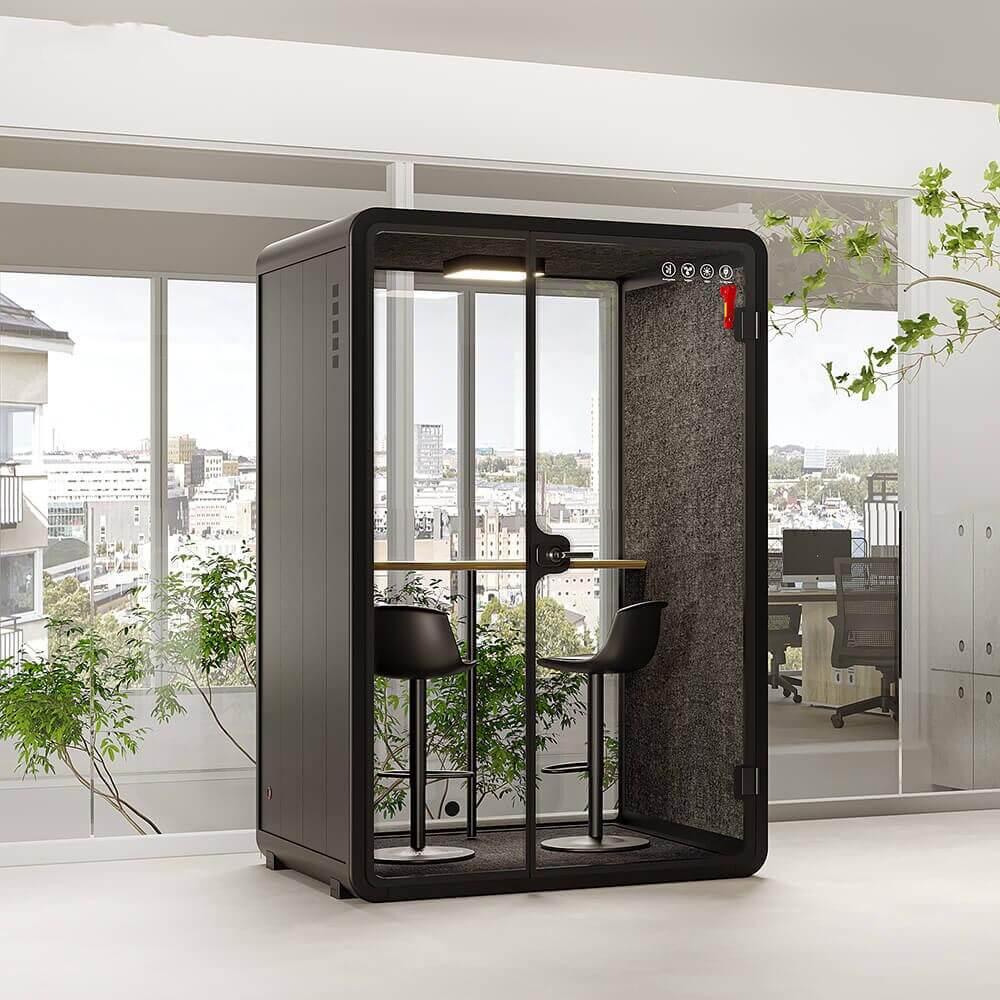
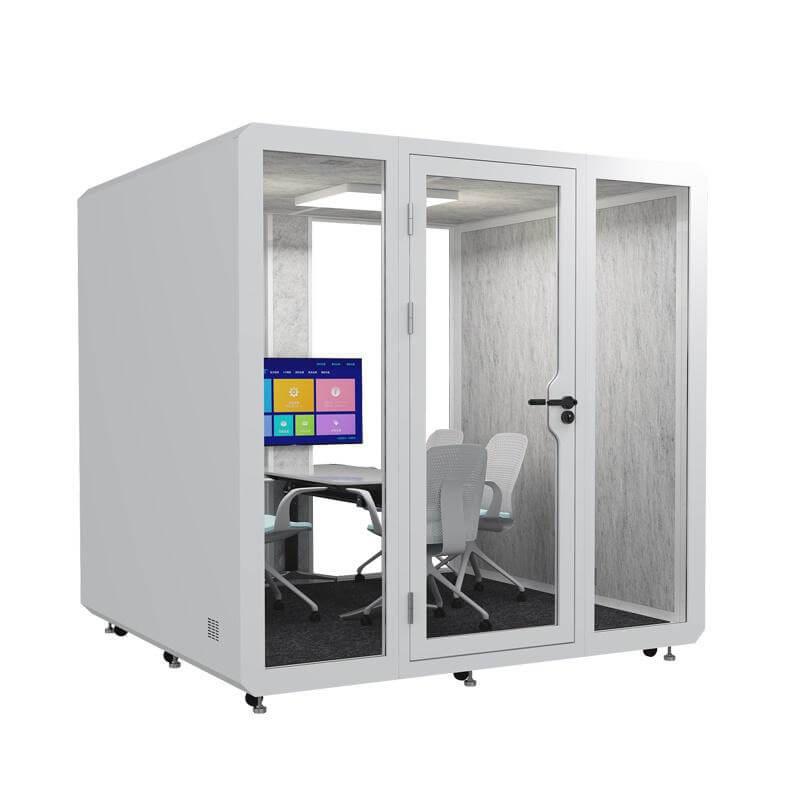
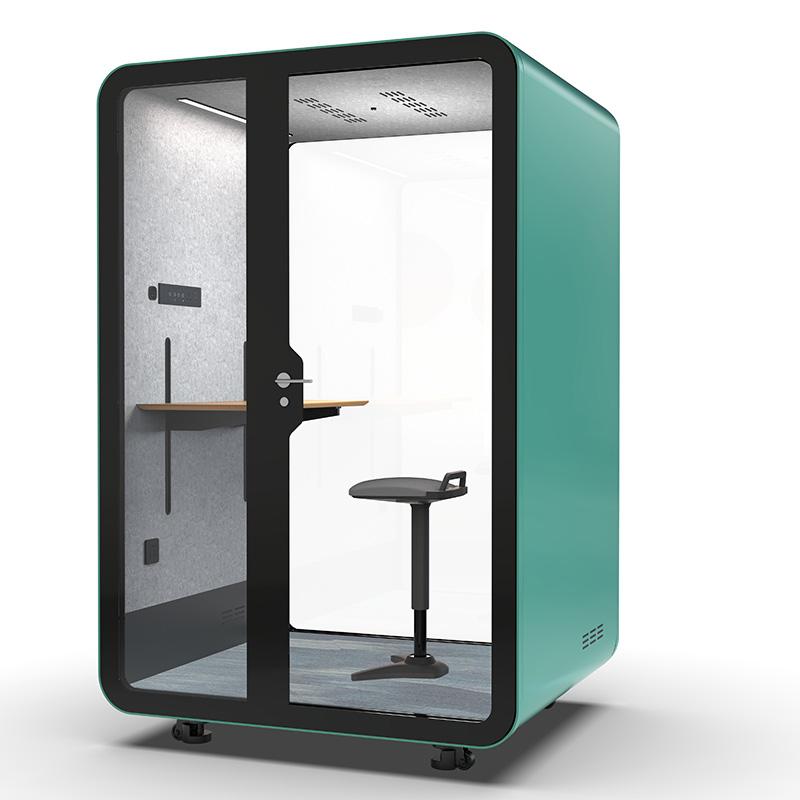
Once the meeting pattern is clear, the team can review the meeting pod category against the actual schedule and floor plan. The product page is a starting point for configuration discussion. The approved drawing, quotation, delivery scope, and acceptance record determine what the project will receive.
Capacity should reflect body movement, furniture, equipment, and the way people behave during the meeting. Two people who sit quietly with laptops occupy a different working envelope from four people who turn toward a shared screen and use paper. A label such as two-person or four-person is useful for initial sorting, but it should not replace an internal layout check.
Ask the supplier for the clear internal arrangement and the position of the table, seat, display, power, and ventilation components. Place paper templates for laptops, notebooks, bags, and a camera on the plan. Then check whether one person can enter while another remains seated, whether the door approach stays clear, and whether the person nearest the wall can leave without disturbing the meeting.
Also consider changeover. If the pod is booked repeatedly, users need a simple way to enter, connect equipment, leave, and reset the table. A layout that works for a staged photograph may become frustrating when every meeting begins with moving a chair or searching for a cable. Record the reset action as part of the use case, especially if the pod will support several teams.
Meeting pods often fail in planning because the drawing shows the pod but not the people waiting outside. Mark the door swing, clear approach, queue position, nearby desks, fire exits, storage, cleaning route, and the path to power and data. The space directly outside the pod influences privacy and convenience just as much as the internal table.
Use the building route as a second drawing. Record the unloading point, package dimensions, lift, stairs, corridor widths, turns, thresholds, temporary storage, and permitted working hours. An assembled product may fit the final room while its shipping packages do not fit the route. If assembly occurs inside the office, identify where packages can be opened without blocking other teams.
| Meeting-pod question | What to draw or record | Reason to pause the order |
|---|---|---|
| Can the group enter naturally? | Door approach, door swing, bags, waiting area | Users must cross a desk zone or block circulation |
| Can the room support the activity? | Clear table, seats, screen, laptops, writing space | Equipment changes the seating or exit path |
| Can the product reach the room? | Package route, lift, turns, thresholds, storage | Only assembled dimensions were checked |
| Can the site support the services? | Power, data, ventilation access, maintenance zone | Connection or service responsibility is not assigned |
Privacy is not a single setting. A project review may need people outside the pod to avoid understanding every word, while a reception or training environment may need visual awareness so that the pod never feels hidden or difficult to supervise. Ask whether the requirement concerns speech privacy, visual privacy, distraction reduction, controlled access, or a combination.
Define the listener positions that matter. Someone seated one metre away, someone walking past the door, and someone working at the far side of the room may experience the same conversation differently. A useful observation records the door state, ventilation state, surrounding activity, listener position, and the type of speech. It should describe what was heard, not claim a universal acoustic rating.
Use product documentation for the exact enclosure under offer. Terms such as quiet, acoustic, soundproof, and private can describe different scopes. The supplier should explain the panel, glass, door, frame, seals, floor, ceiling, and ventilation arrangement that make up the offered system. If an acoustic report is supplied, preserve its test conditions and limits.
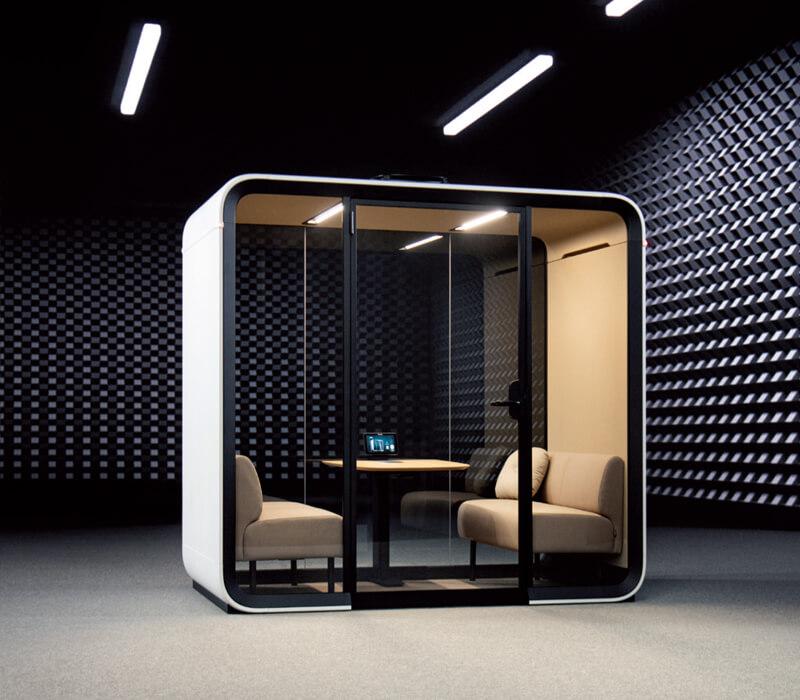
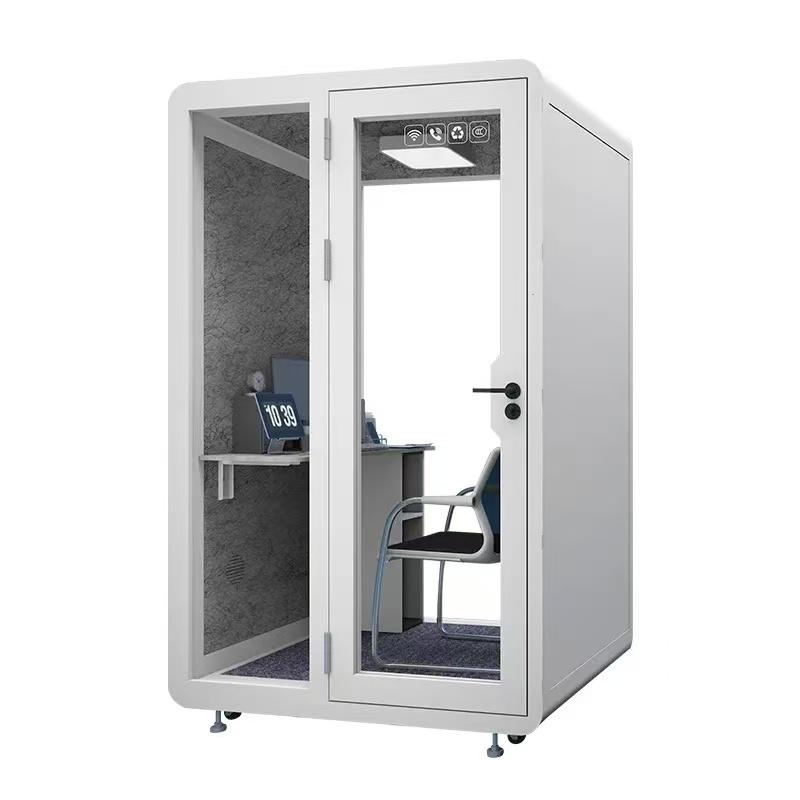
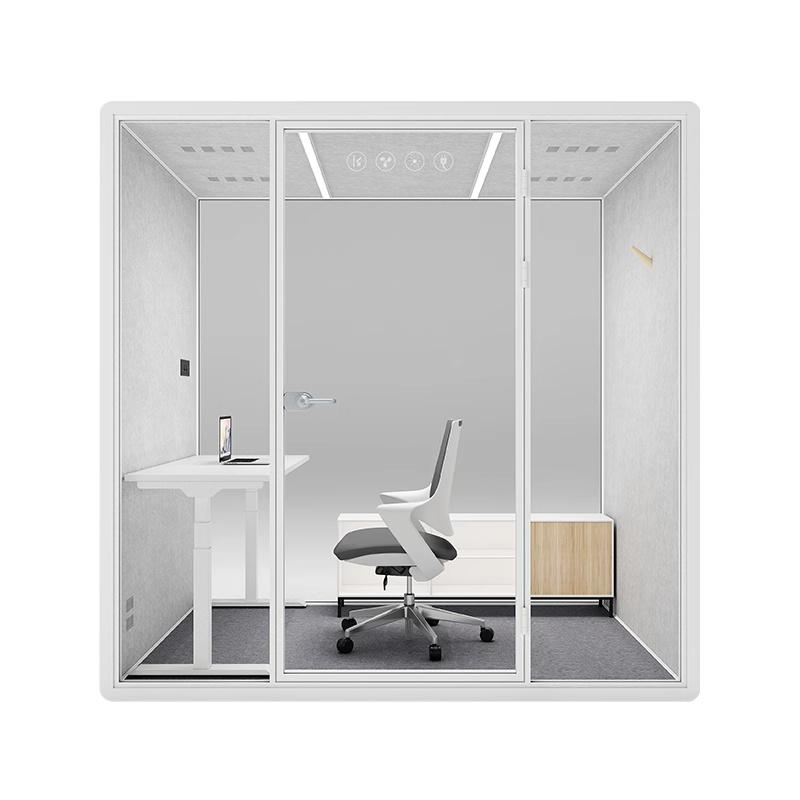
Do not leave furniture until the final quotation. Mark the table edge, chair positions, screen, camera, laptop, documents, power sockets, and charging cables on a full-size plan. A meeting pod should let participants see one another, reach the table, connect their equipment, and leave without moving a fixed component. If the pod serves different meeting types, draw the most demanding common arrangement instead of relying on the least crowded example.
Consider the communication pattern. A two-person coaching session may work face to face. A project meeting may need a screen at one end. A hybrid meeting may need the camera to see every participant without placing a bright window behind them. These decisions affect table orientation, lighting, door location, and power. They should be written into the configuration request so that a supplier does not price a visually similar but operationally different version.
Furniture finish and maintenance also matter. Shared meeting surfaces collect marks, food, and equipment wear. Ask how the surface is cleaned, where users place personal items, and how a damaged component is replaced. Do not invent a material guarantee or service promise. Record the question and the supplier's exact answer in the project file.
Comfort should be evaluated during the longest normal meeting. Place the actual number of people in the intended positions and operate the fan, lighting, screen, and door as users will. Observe heat, air movement, fan sound, glare, reflections, posture, and the time needed to reset the space. A short empty-booth inspection cannot answer all of these questions.
Lighting is part of communication quality. Faces should remain visible for a video call, documents should be readable, and a screen should not reflect a strong source behind the participants. Mark windows, ceiling fittings, display direction, and camera position on the plan. If the product has adjustable controls, record the available operating method and the person responsible for explaining it to users.
Ventilation questions must stay tied to the offered model. Ask where air enters and exits, how controls are reached, what maintenance access is needed, and what the operator should check when the pod feels warm. Avoid adding an unsupported air-change or fan-noise number simply to make the article sound technical.
Delivery is not finished when the vehicle reaches the building. The responsibility map should name unloading, internal movement, floor protection, package storage, assembly, service connection, packing removal, damage reporting, and final cleaning. The Italian project team may have a local installer, a building contractor, or a supplier crew. Each model can work if the handoff is explicit.
Ask for a package schedule and the assumptions behind it. Record the number of packages, dimensions, gross weight, lifting needs, and whether the product is assembled before or after entering the room. The team should also confirm whether the final position needs floor protection, temporary closure of a corridor, or permission to work outside normal office hours.
Local property and building requirements are a confirmation task. A buyer should ask the responsible local professionals about access, electrical connection, fire strategy, accessibility, floor condition, and any landlord approval. The article should explain the questions without presenting an unverified national rule as if it were a legal conclusion.
Acceptance should follow a short meeting script instead of relying on appearance. Inspect the delivered product against the approved drawing and options. Check surfaces, glass, door alignment, seals, table, seats, lighting, outlets, controls, ventilation, cable routes, and service access. Then ask two or more intended users to run the ordinary meeting pattern, including entry, connection, conversation, screen use, departure, and reset.
Record the conditions of the observation. Note the number of people, equipment, door state, ventilation setting, surrounding activity, and any privacy concern. If an item is not ready, assign an owner and a closure record. A completed handover should contain the correction list, photographs, approved documents, cleaning instructions, warranty route, and contact process for service questions.
Use the result to refine the booking and user instructions. If a pod is intended for short meetings, make that operating assumption visible. If users need to reserve it, explain the reset and cleaning expectation. The success of a meeting pod depends on the relationship between product, room, people, and process, not only on the enclosure.
How should a buyer choose the capacity of a meeting pod?
Start with the largest normal meeting pattern, including seats, table, laptops, documents, screen, camera, and the need for people to enter or leave. Use the product label for initial sorting, then verify the clear internal arrangement against a full-size plan.
Does a private meeting pod guarantee complete speech privacy?
No universal guarantee should be assumed. Review the exact enclosure, door, frame, seals, floor, ceiling, ventilation path, listener positions, and supplied evidence. The practical result depends on configuration and surrounding conditions.
What should be checked outside the pod?
Check door swing, approach space, waiting position, nearby desks, circulation, exits, cleaning access, power, data, and maintenance clearance. A pod can be comfortable inside and still create a layout problem outside.
Which documents belong in the handover file?
Keep the approved drawing, options, finish record, package schedule, responsibility map, installation photographs, service instructions, correction log, warranty terms, and final activity observation.
A private meeting pod should be planned from the meeting rhythm, the people, the equipment, and the space around the door. A clear Italian project brief can then compare capacity, privacy, comfort, delivery, service boundaries, and acceptance without relying on a generic product label.
The next useful step is to draw one realistic meeting pattern, measure the access route, request a configuration-specific quotation, and ask local project professionals to confirm building interfaces. That evidence will make the final decision more reliable than a staged image or an unsupported country-specific claim.

 Tel: +8613538031763
 Email: info@sopworkpod.com
 MP/WhatsApp: +8613538031763
 Manufacturer Address:Liucheng Lujiang District,Meixi Road,Nanan City,Fujian,China