
Need Help?
Please leave your contact information to get our latest catalog
Get In Touch Now >


Author:SOP Work Pods Manufacturer TIME:2026-08-28
A crowded meeting calendar, complaints about open-office noise, and employees taking calls in corridors can all create pressure to buy soundproof booths. They do not describe the same investment problem. The meeting calendar may be blocked by one-person video calls, noise complaints may come from collaboration zones, and corridor calls may reflect poor booking practice rather than missing enclosures. Buying before separating those signals can move the problem without resolving it.
Modern offices invest rationally when a booth is tied to displaced work. Displaced work is a task that cannot be completed suitably in its current place and therefore consumes another room, interrupts nearby employees, exposes information, moves off the floor, or is delayed. The investment case identifies that task, the constraint causing displacement, the available alternatives, and the evidence that a booth can support the work in the proposed location.
This is a capital allocation decision, not a trend report. It includes delivered scope, floor-space consequences, service and downtime ownership, future change, and the possibility that policy or layout changes are better controls. A bounded pilot tests the hypothesis before a broad rollout. Expansion follows a recorded trigger, not the novelty of the first installation.
Start with failed or displaced tasks. Record the work type, time pattern, participants, device and material needs, privacy consequence, current location, reason that location fails, and what happens next. A person may take a sales call in a stair lobby, occupy a meeting room alone, postpone a sensitive conversation, leave the floor, or continue at a desk while neighbors are disturbed. Each outcome creates a different cost or risk route.
Distinguish persistent demand from a short event. A temporary project, office move, seasonal call pattern, broken meeting room, or new attendance policy may create a spike that does not justify permanent capacity. Observe several contrasting operating periods and preserve the context. Do not invent utilization forecasts from a single busy afternoon.
Identify the constraint behind each displacement. It may be intelligible speech at nearby desks, visible screens, lack of a reliable video setup, no room for a brief call, excessive transition time, or booking rules that reserve large rooms inefficiently. The constraint must be specific enough that a pilot can show whether it changed.
Assign an expected destination. A one-person booth may support routine calls but not a confidential two-person review; a meeting pod may solve occupancy while consuming more floor area; a policy change may handle brief low-risk calls without construction. The investment case becomes credible when it states which displaced tasks will move and which will not.
Add the burden carried by the present workaround. Room administrators may repeatedly move bookings, employees may spend time searching for a private place, IT may support improvised devices, and teams may protect a scarce room because no smaller option is dependable. Describe these activities and their frequency from actual records where available. They help compare interventions without converting assumptions into invented financial savings.
| Observed demand signal | Work displaced or disrupted | Alternative to compare | Pilot release evidence |
|---|---|---|---|
| One-person calls occupy meeting rooms | Group rooms become unavailable | Booking change, room mix, or individual booth | Assigned calls move without losing privacy or call quality |
| Corridor calls recur | Work leaves the team zone and may expose speech | Call policy, remote route, zoning, or enclosure | Named task completes in the proposed location |
| Desk neighbors report disturbance | Concentration and calls compete in one zone | Adjacency, behavior, acoustic treatment, or booth | Disruption route changes without creating another affected zone |
| Existing booth queues form | Calls wait, relocate, or use unsuitable spaces | Scheduling, relocation, repair, or added capacity | Denied demand crosses the prewritten expansion rule |
Compare interventions against the same constraint. For room scarcity, consider booking rules, releasing underused rooms, improving room technology, reassigning room types, remote options, and pods. For speech disturbance, consider zoning, behavioral agreements, headset practice, adjacency changes, and enclosures. An alternative is not free merely because no product is purchased; it can require management time, employee movement, lost capacity, or recurring support.
Preserve what each option cannot do. Policy cannot create a confidential listener boundary where the room remains exposed. A pod cannot correct every collaboration-zone behavior. Better technology may reduce call friction but leave visual privacy unresolved. A conventional room may provide stronger capability while remaining too scarce for routine individual calls. Conditional comparison avoids declaring one format superior across unrelated work.
Include floor-space displacement. Mark footprint, approach, door movement, waiting, circulation, maintenance access, ventilation relationship, power and data routes, and delivery. The unit may replace desks, storage, informal collaboration, or future flexibility. This opportunity cost belongs beside purchase and installation scope even when it has no simple monetary value.
Test the no-purchase case explicitly. Ask what happens if the organization repairs booking, rebalances rooms, improves call equipment, or changes adjacency while keeping the current estate. A soundproof booth is stronger as an investment when those credible steps leave a defined task unresolved, not when alternatives are dismissed without trial or assigned no implementation effort.
Use the soundproof booth product range only after the task and alternative map is stable. Attach the exact booth role, configuration, and proposed zone to the comparison. A broad product family cannot serve as the approved investment unit because size, options, service interfaces, and occupancy may change the delivered result.
Acoustic value must stay within evidence conditions. Ask for applicable information on the offered model and installation, then define relevant listener points and call types in the office. Observe whether meaningful speech remains followable and whether external activity distracts the occupant. Do not turn one specification or field walk into a universal soundproof promise.
Add visual, technology, and occupied-use boundaries. Screen sightlines, camera and microphone setup, wireless reliability, device volume, lighting, controls, equipment heat, airflow perception, posture, and session length can determine whether the displaced task actually fits. A booth that appears acoustically suitable but fails its normal work sequence cannot deliver the planned capacity.
Normalize the delivered offer. Include model and options, furniture, finishes, electrical and data interfaces, delivery, assembly, site protection, commissioning, training, cleaning information, warranty, service response, replacement items, and any client-side work. Quotes with different boundaries do not provide a fair investment comparison.
Map lifecycle burden to owners. Routine inspection, cleaning, control faults, damaged seals, ventilation service, network support, booking, parts, relocation, and recommissioning may involve different parties. Downtime matters because a failed booth pushes the assigned work back to its former location. A fallback should be planned before that failure occurs.
Examine concentration risk in service and parts. If only one provider can perform a critical adjustment, a replacement control has uncertain availability, or software support governs an essential function, record the dependency and fallback. This does not automatically reject the booth. It changes the operating reserve, contract question, and value assigned to features that cannot degrade gracefully.
Write a hypothesis that can fail. For example, a named booth in a named zone may absorb a defined class of individual calls that currently displaces larger meeting rooms, while maintaining the required privacy, technology, access, and comfort boundaries. State what observation would reject the hypothesis, such as repeated task abandonment, unacceptable listener exposure, blocked circulation, support burden, or no reduction in displaced work.
Run the pilot across credible operating states. Include peak and quieter periods, normal devices, representative users, consecutive calls, the intended booking route, and ordinary surrounding activity. Track completed assigned tasks, denied demand, tasks moved elsewhere, faults, support requests, early exits, reset failures, and the condition of the alternatives. Numbers can be recorded locally without publishing unsupported claims.
Review side effects. The booth may create a waiting cluster, move noise toward another team, reduce useful open area, increase support work, or encourage high-consequence calls beyond its approved boundary. Correct site or policy issues during the pilot, but retain the original condition and change so the final review can distinguish product fit from implementation quality.
Set a scale trigger before the pilot ends. Expansion might require repeated denied demand for the supported task, stable completion of the occupied work cycle, closed fault ownership, and no better use of another intervention. Relocation or rejection needs its own trigger. Capital discipline means the next action follows evidence gathered against the original hypothesis.
Present the final review as choices with consequences. Continue the pilot when a bounded uncertainty needs another operating state; expand when the prewritten evidence is complete; relocate when site effects dominate; alter the service when booking or support is the main barrier; or stop when the task remains unsuitable. Keeping these options open prevents a purchased pilot from becoming an automatic commitment.
Retain the baseline for the next capital request. A later proposal should show whether the original displacement persisted, which corrective actions succeeded, how the first unit remained serviceable, and whether another location can reproduce the accepted conditions. This turns a pilot into reusable governance rather than a promotional display.
No. High bookings may reflect genuine demand, scarcity, novelty, long reservations, poor alternatives, or users holding a unit while absent. Pair booking patterns with denied demand, completed task observations, fault status, and what users do when the booth is unavailable.
Sometimes. Policy, zoning, room allocation, or technology may address a defined constraint. They cannot create every required speech or visual boundary. Compare each intervention against the same displaced task, consequences, operating effort, and failure conditions.
Include the exact configuration, delivery, assembly, site work, power and data interfaces, floor-space impact, commissioning, training, routine service, cleaning, parts, downtime response, relocation, and eventual change. Keep exclusions and owners visible instead of relying on base price.
Stop or pause when a non-negotiable privacy, access, safety, circulation, technology, comfort, or ownership condition remains unresolved; when the assigned work repeatedly fails; or when a better intervention addresses the displacement with less burden. Preserve the evidence and corrective attempts.
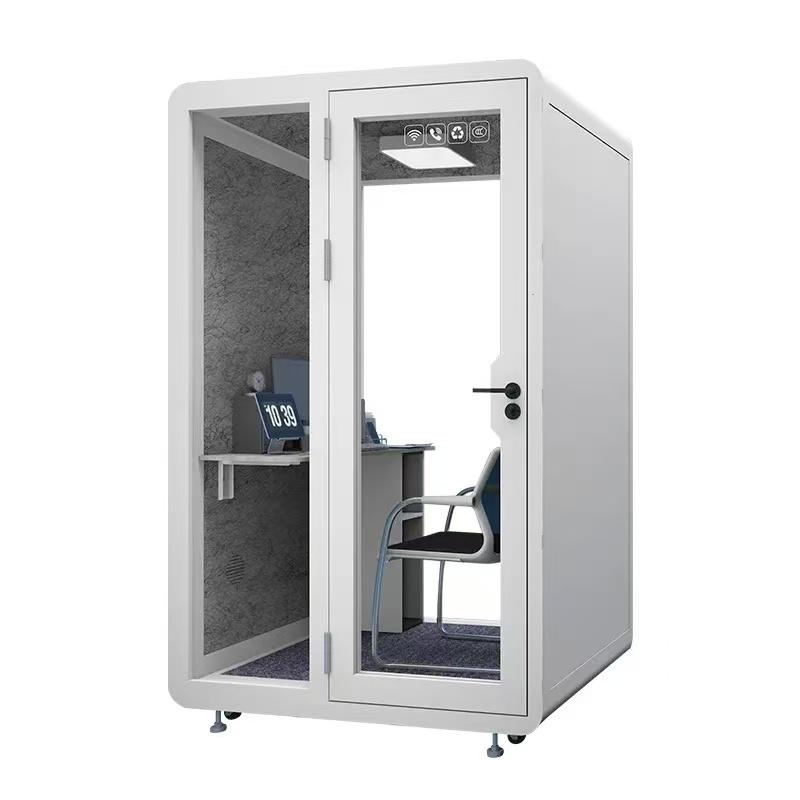
Modern offices have a sound reason to invest in booths when specific work is repeatedly displaced and the proposed enclosure supports that work better than credible alternatives under a defined installed condition. Demand signals, feature interest, and a general wish for quiet are starting observations rather than the investment case.
Select one displaced task, compare its alternatives, and release a bounded pilot with explicit rejection and scale triggers. Fund broader capacity only when the task moves as intended, privacy and occupied-use limits hold, side effects remain controlled, and lifecycle ownership is ready for the next unit.
To price a bounded booth pilot, share the displaced work, quantity, placement options, and required call setup through the inquiry form or WhatsApp.

 Tel: +8613538031763
 Email: info@sopworkpod.com
 MP/WhatsApp: +8613538031763
 Manufacturer Address:Liucheng Lujiang District,Meixi Road,Nanan City,Fujian,China