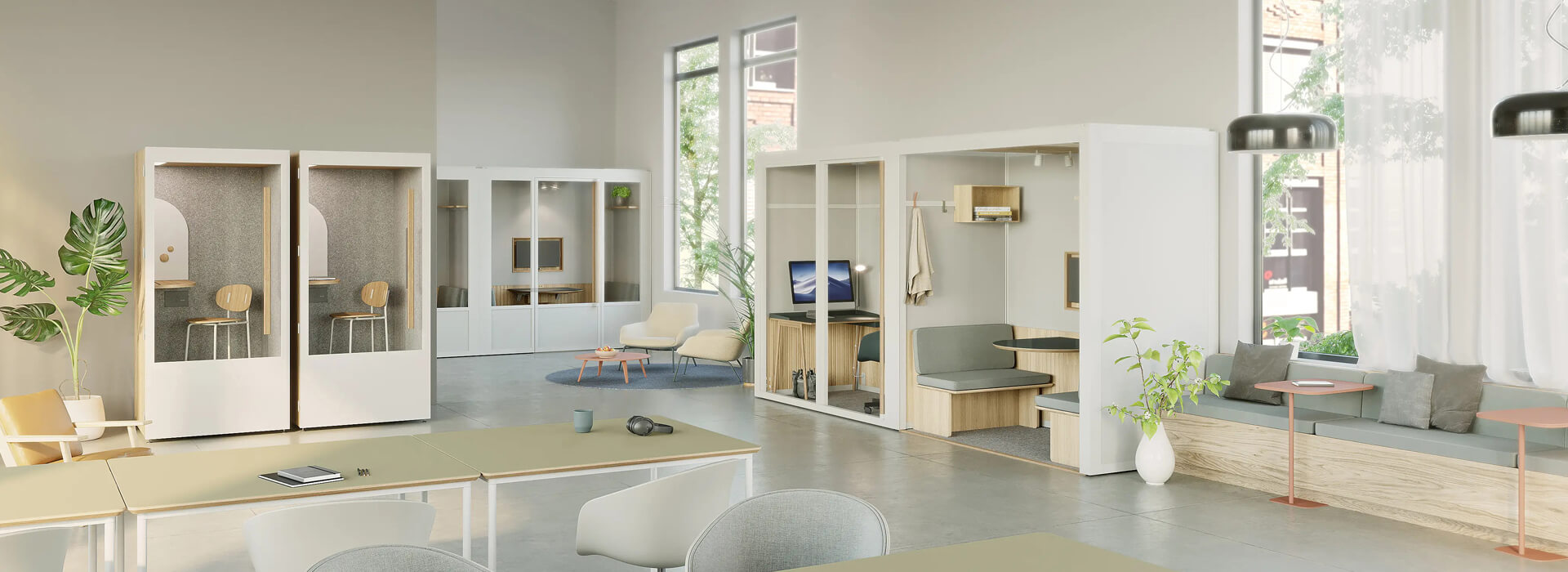
This outdoor office pod catalog introduces enclosed workspace options for gardens, courtyards, hospitality settings, campuses, and other exterior locations. Outdoor placement adds decisions that do not apply to an indoor booth: ground conditions, water management, weather exposure, thermal comfort, utility routes, delivery access, planning responsibility, and long-term exterior maintenance.
Record who will use the pod, in which seasons, for how many hours, with what equipment, and under whose management. A private home office, a hotel meeting room, a campus study space, and a public-facing consultation room create different access, safety, service, cleaning, and security requirements.
Mark orientation, sun, shade, wind exposure, nearby trees, drainage paths, boundaries, pedestrian routes, vehicle access, and surrounding activities. Country or climate labels are too broad for final design. The responsible project team should confirm actual site conditions and applicable local requirements.
Ask how the proposed configuration manages roof and wall interfaces, openings, door thresholds, glazing, seals, drainage, condensation risk, corrosion exposure, and maintenance access. Request product-specific information for the intended location rather than assuming that an indoor acoustic pod can be placed outside without changes.
Thermal comfort depends on enclosure construction, glazing, orientation, occupancy, equipment heat, ventilation, and any heating or cooling system. Define the expected occupied condition and energy responsibility. Avoid treating a catalog statement as a guarantee for every temperature, wind, rainfall, or exposure condition.
Confirm the required foundation or support condition, level tolerance, anchoring approach, drainage, finished floor height, and route for future inspection. Ground works should be coordinated with the pod supplier and qualified local professionals. The interface between the supplied pod and site-prepared base must have one clear owner.
Measure the delivery route from vehicle access to final position. Include gate width, overhead restrictions, turning space, lifting method, ground bearing, temporary storage, landscaping protection, package sizes, assembly area, and weather contingency. The outdoor garden pod range can help identify current options, while the final logistics plan should use the selected model's packed and assembled information.
| Project interface | Question to resolve | Required record |
|---|---|---|
| Ground and drainage | Who designs and prepares the base, level, anchors, runoff, and surrounding finish? | Approved site drawing |
| Envelope | Which weather, glazing, door, seal, and maintenance assumptions apply? | Configuration and care schedule |
| Power and data | Who provides routes, protection, connection, testing, and future access? | Service responsibility matrix |
| Delivery and assembly | Who unloads, lifts, moves, protects, assembles, cleans, and removes packaging? | Delivery method statement |
| Approval and use | Which local reviews, operating rules, and handover checks are required? | Project approval and acceptance file |
Keep the catalog, quotation, drawing, site design, service plan, and acceptance checklist on the same revision. If an interface remains unresolved, assign an owner and decision date before production or ground work begins.
Can an indoor office pod be installed outdoors?
Only if the exact configuration is designed and approved for the intended exterior conditions. Verify the enclosure, base, drainage, services, and maintenance requirements.
Does the catalog include foundations and utilities?
Do not assume so. Ask for an itemized responsibility schedule covering ground works, power, data, heating or cooling, delivery, assembly, and testing.
What should be checked before ordering?
Confirm site purpose, local review responsibilities, exposure, ground condition, drainage, access, utilities, configuration, delivery method, and acceptance plan.
An outdoor office pod is a product-and-site project, not a standalone item placed on any open surface. Use the catalog to shortlist a configuration, then resolve weather, ground, utilities, logistics, local review, and maintenance boundaries before approval.
 Loading...
Download our latest Outdoor Office Pod catalog to
explore product features,
models, and technical specifications. Submit the form to get instant
access.
Submit & Download
Loading...
Download our latest Outdoor Office Pod catalog to
explore product features,
models, and technical specifications. Submit the form to get instant
access.
Submit & Download

 Tel: +8613538031763
 Email: info@sopworkpod.com
 MP/WhatsApp: +8613538031763
 Manufacturer Address:Liucheng Lujiang District,Meixi Road,Nanan City,Fujian,China